How Does a Jumble Solver Actually Work?
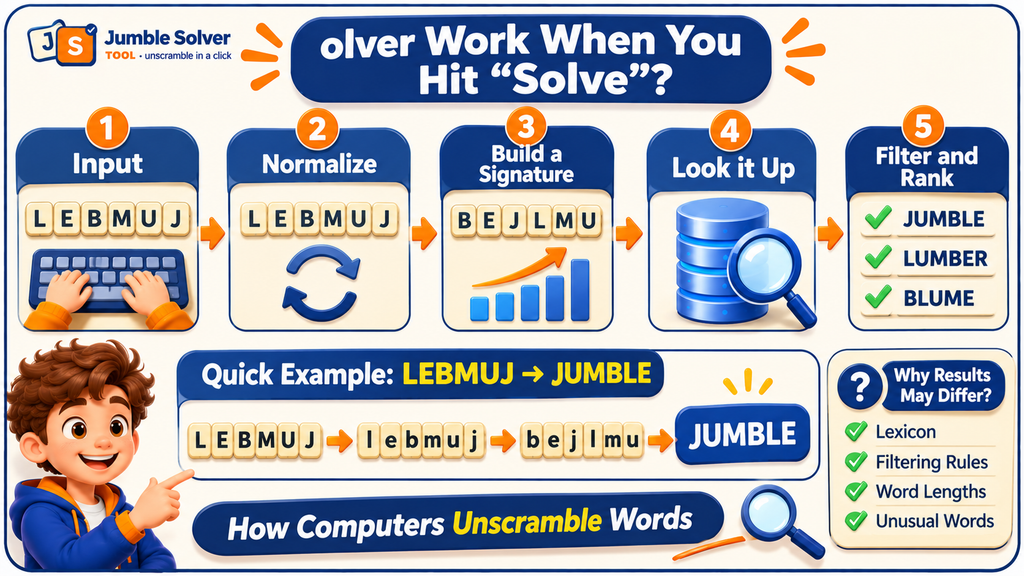
How does a jumble solver work? It takes your scrambled letters, cleans them up, and compares them against an organized word list. It filters out words that can’t be spelled with those letters and returns the valid matches, usually in a fraction of a second.
If you’re wondering what is a jumble solver useful for, think of that one Daily Jumble word that just won’t budge. The puzzle dates back to 1954, and its scrambled words are essentially small anagram problems. Here is what the software does behind the scenes.
How Does a Jumble Solver Work When You Hit “Solve”?
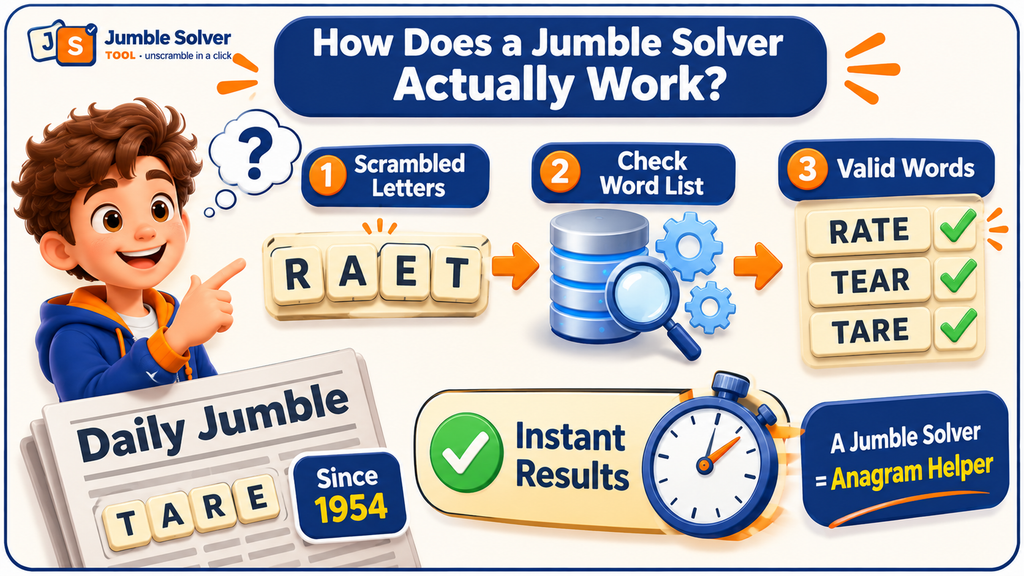
So, how does a jumble solver work after you hit “Solve”? The exact code differs, but a common approach follows five steps.
The Process in 5 Steps
- Input: You enter scrambled letters, such as LEBMUJ.
- Normalize: The tool converts them to one case and removes spaces, numbers, or symbols. Wildcards like ? are handled separately.
- Build a signature: Using alphabetical sorting, the letters can be put into a standard form.
- Look it up: That signature is checked against an indexed word list using dictionary lookup.
- Filter and rank: The tool removes invalid matches and sorts the remaining valid words by its rules, such as word length.
Quick Example: LEBMUJ → JUMBLE
LEBMUJ → lebmuj → bejlmu → JUMBLE
That simple match shows how computers can unscramble words: they compare letter patterns and retrieve matching words from an index.
See it in action with our free Jumble Solver.
Why Your Results May Look Different
Two solvers can receive the same scrambled letters and still return different lists. The difference may come from the lexicon, filtering rules, allowed word lengths, or treatment of unusual words, not necessarily from one solver making a mistake.
Where Does a Jumble Solver Get Its Words?
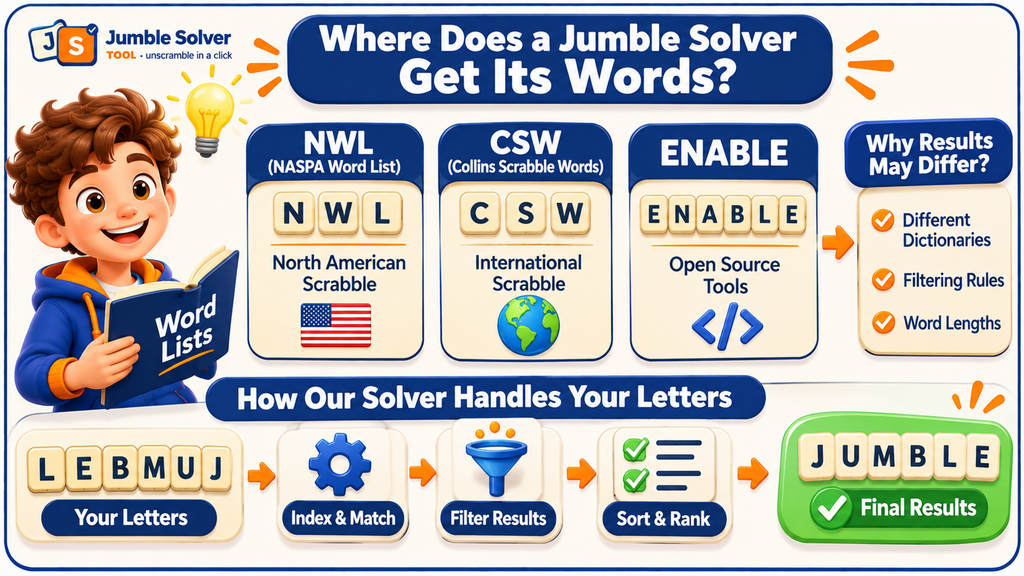
A solver is only as good as its word unscrambler dictionary, sometimes called a lexicon. Different tools may build their results from different word lists:
| Word list | Common use |
| NWL (NASPA Word List) | North American competitive Scrabble |
| CSW (Collins Scrabble Words) | International competitive Scrabble |
| ENABLE | Open-source and hobby word tools |
The NWL vs CSW vs ENABLE word list difference helps explain why two solvers can return different answers from the same letters. One may accept a rare Scrabble word while another leaves it out because its dictionary or filtering rules are different.
That also explains some strange-looking results. A large competitive-game lexicon can contain words you rarely see in everyday writing. For Daily Jumble, useful results depend not just on having a large list, but on filtering it well.
Editor’s note: Before publishing, add the exact word list and filtering rules used by our Jumble Solver Tool.
How Our Solver Handles Your Letters
CLIENT/DEVELOPER NOTE — replace this box with verified first-hand details before publishing:
State which word list or lexicon the Jumble Solver actually uses, how its word data is indexed, how duplicate letters and wildcards are handled, and how results are filtered or ranked. Include only features confirmed by the developer. If the solver uses a sorted-letter index, letter-frequency matching, or another method described below, identify the actual method here.
How Does a Jumble Solver Work Behind the Scenes? 3 Methods
There isn’t a single jumble solver algorithm. Developers can use different approaches depending on what the tool needs to find.
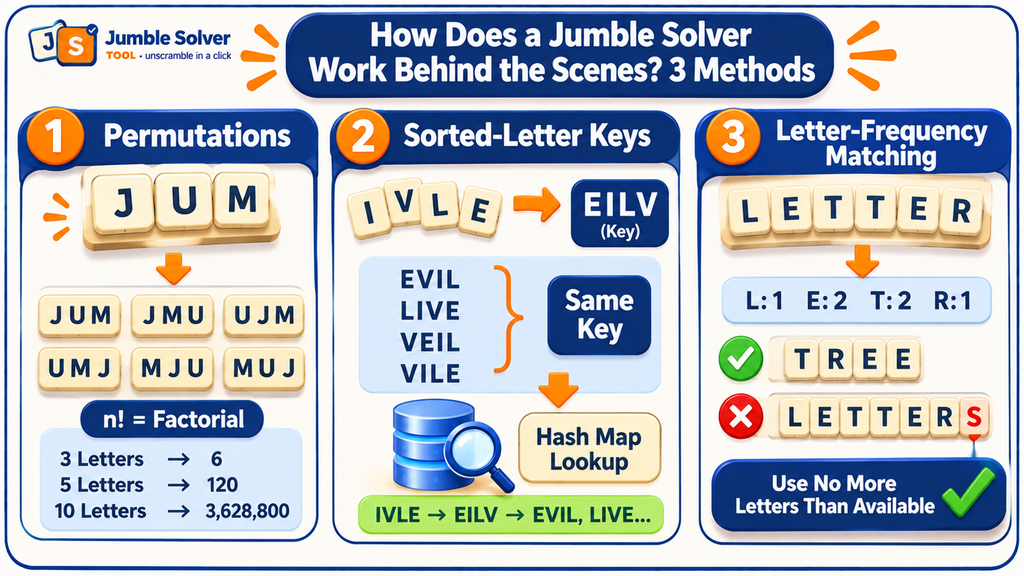
1. Trying Every Arrangement: Permutations
The most obvious method is brute force. The program generates every possible order, or permutation, of the letters and checks each one against a dictionary.
With J, U, and M, there are six arrangements:
JUM, JMU, UJM, UMJ, MJU, MUJ
The number of arrangements is the factorial of the letter count, written as n!:
- 3 letters: 6
- 5 letters: 120
- 10 letters: 3,628,800
A permutation word solver works fine for short inputs. As the letter count grows, though, it spends more time generating combinations that aren’t words.
2. Sorted-Letter Keys: The Faster Shortcut
A more efficient sorted letters anagram method flips the problem around. Instead of generating arrangements every time, the tool can prepare its word list in advance.
Each word gets a key through alphabetical sorting:
EVIL → EILV
LIVE → EILV
VEIL → EILV
VILE → EILV
All four share the same canonical key, or signature. The solver can store them in a hash map (also called a hash table), where that key points to every matching word.
So, how does an anagram solver work with this setup? Enter IVLE, and the program sorts it to EILV. A dictionary lookup for that key can return EVIL, LIVE, VEIL, and VILE without generating every arrangement. This anagram hash map sorted key approach moves much of the work to the prebuilt index.
The lookup itself is very fast on average, but the input still has to be sorted and the index built beforehand. The shortcut is big, just not free.
See the same idea in action with our anagram solver.
3. Letter-Frequency Matching: Finding Smaller Words
Sorted keys work well when every letter must be used. Scrabble, Words With Friends, and Text Twist also need to find smaller words made from part of a rack.
For that, a solver can build a letter-frequency count, or histogram:
LETTER → L:1, E:2, T:2, R:1
It then compares each candidate with the available counts. TREE passes because it needs T:1, R:1, and E:2. LETTERS fails because it needs an S that isn’t there. A sub-anagram survives only if it never uses more of any letter than the rack contains. That’s the basic idea behind how word unscramblers work when they return shorter words from the same set of letters.
How Do Wildcards and Blank Tiles Work?
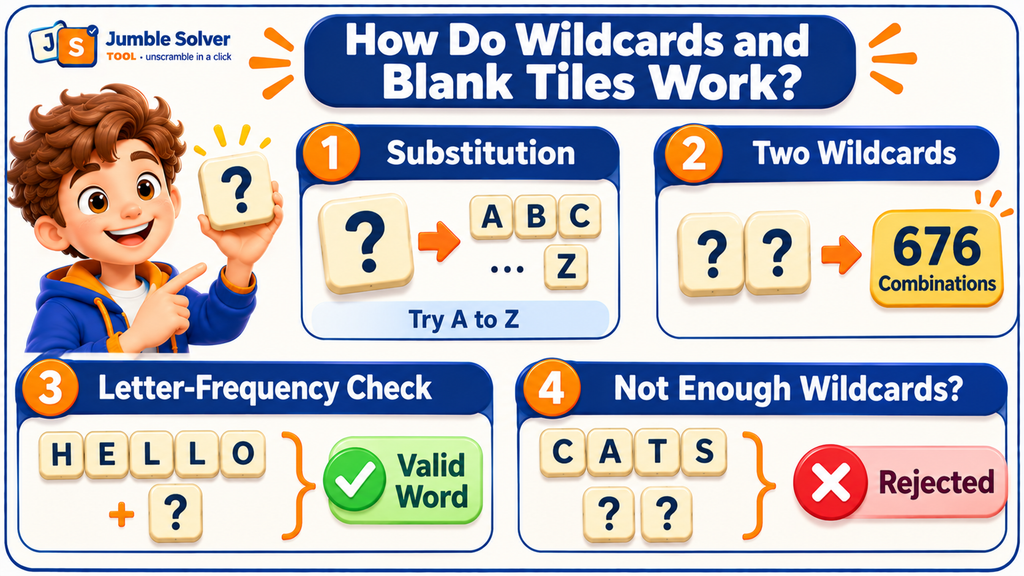
So, how do wildcards work in word unscramblers? A wildcard, usually typed as ? or *, stands for an unknown letter, much like a blank tile in Scrabble.
The simple approach is substitution. The solver replaces the wildcard with each letter of the alphabet, from A through Z, and runs the search again. With two wildcards, that creates 676 possible letter combinations.
A more efficient approach can include the wildcard in a letter-frequency count. If a candidate needs one letter you don’t have, the wildcard can cover that gap. If the word needs more missing letters than you have wildcards, it is rejected.
Stuck with a missing letter? Try our word unscrambler and check the possible matches.
What About Tries, DAWGs, and Scrabble Engines?
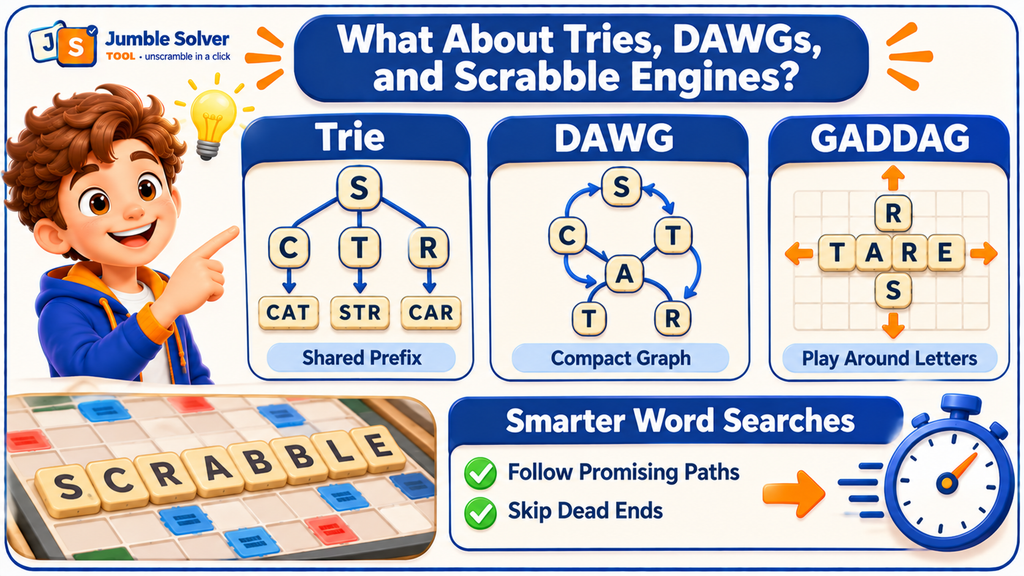
Large word-game engines can store words in structures that avoid checking every possibility. In a trie, words beginning with the same letters share a path. During a prefix search, the program can stop as soon as that path leads nowhere.
A DAWG (directed acyclic word graph) stores similar word paths more compactly, while a GADDAG is designed for finding playable words around existing letters on a Scrabble board. These structures let a word search follow promising letter paths instead of scanning unrelated words.
A basic Daily Jumble tool may not need this extra machinery. A Scrabble engine, where many possible moves must be checked, has more reason to use it.
Which Method Is Faster?
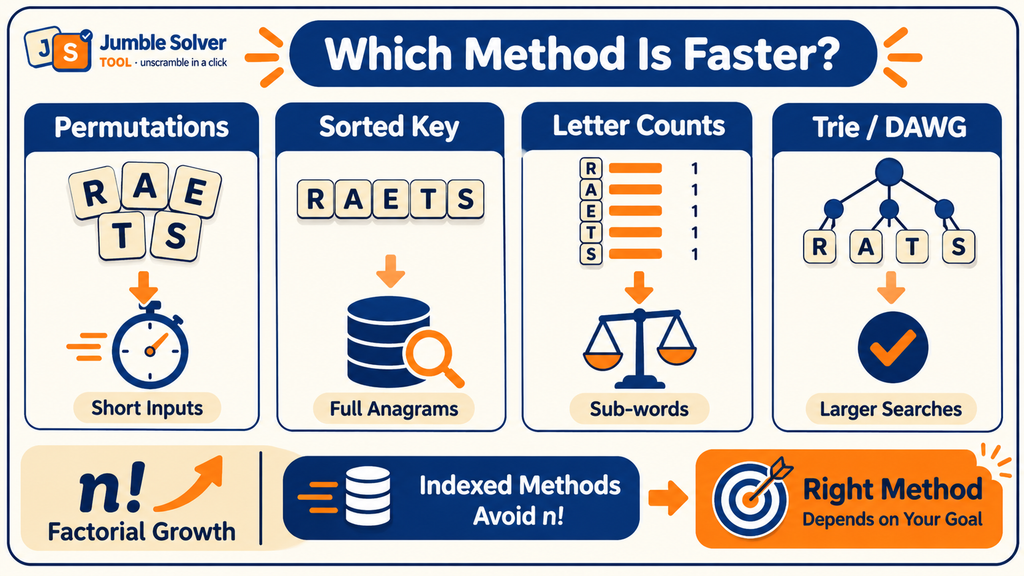
It depends on the job. Permutations suffer from factorial growth as inputs get longer, while index-based methods do much of their work before you ever type a letter.
| Method | Basic idea | Best suited to |
| Permutations | Generate arrangements and check them | Short, simple inputs |
| Sorted key | Match identical signatures with a lookup | Full anagrams |
| Letter counts | Compare available letters with a word’s needs | Sub-words and rack games |
| Trie / DAWG | Follow valid letter paths | Larger word-game searches |
For jumble solver time complexity, brute-force permutation generation grows with n!. In Big-O terms, that becomes expensive quickly. Indexed approaches avoid that factorial search, but real-world speed still depends on the algorithm, word list, index structure, and implementation.
The Important Difference Isn’t Just Speed
The methods above solve slightly different problems. A sorted signature is convenient when every letter must be used, while letter counts are more useful when shorter words are allowed. A trie becomes more valuable when the search needs to follow valid letter paths. So the “best” algorithm depends on what the solver needs to return.
Can AI Tools Like ChatGPT Solve Jumbles?
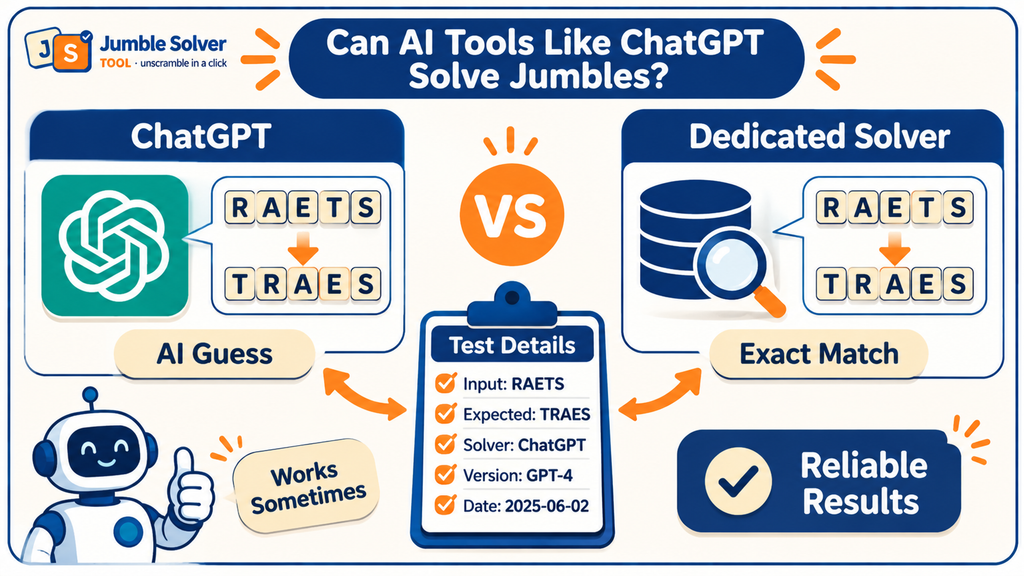
So, can ChatGPT solve jumbles? Sometimes, but not in the same way a purpose-built solver does.
An LLM such as ChatGPT, Claude, or Gemini processes text through tokenization, where tokens may represent whole words, parts of words, or individual characters. It is not inherently a deterministic character-matching engine that simply counts letters against a fixed word list.
That doesn’t mean AI can’t unscramble words. It can solve many examples, especially familiar ones. The difference is how the answer is produced. A dictionary-based solver can compare the exact letters with its word list and return matches that follow those rules. An AI response may occasionally add, drop, or repeat a letter.
That distinction matters when asking can AI solve word jumbles reliably. Rather than assume one approach is more reliable, we can compare them using the same set of scrambled words. The test should record the exact inputs, expected answers, solver results, AI model and version, and testing date.
What a Jumble Solver Still Can’t Do Well
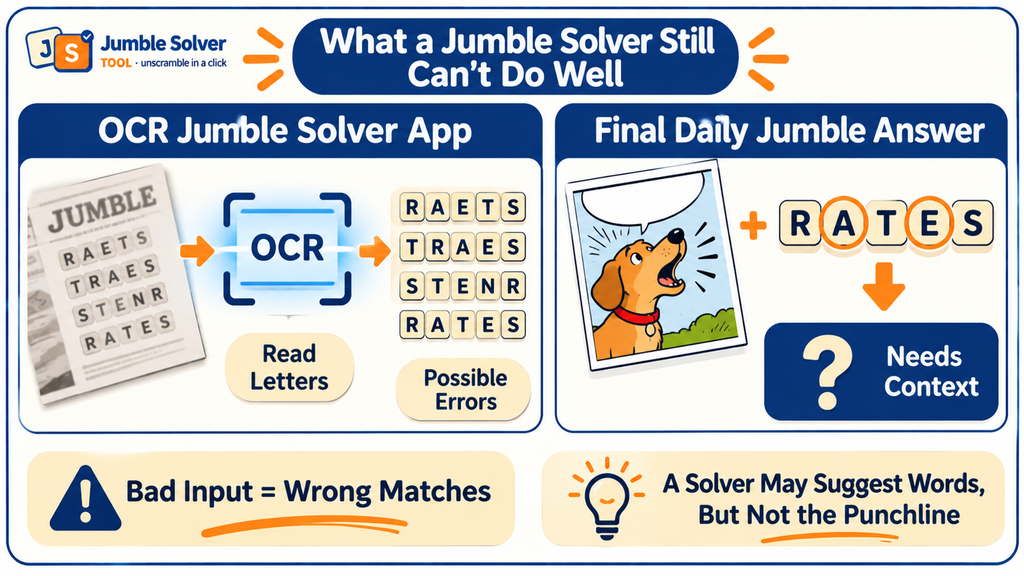
An OCR jumble solver app has an extra step before any unscrambling begins. OCR (optical character recognition) first has to read the letters from the photo. Blurry images, unusual fonts, shadows, tilted pages, or recognition mistakes can turn the puzzle into bad input—and bad input leads to wrong matches.
But can a jumble solver solve the final Daily Jumble answer? That is harder. The final answer uses circled letters, but it also depends on the cartoon clue, context, and wordplay. Finding dictionary-valid anagrams is mainly a letter-matching problem; understanding which phrase completes the joke is a different task. A solver may suggest possible words, but that alone doesn’t reliably reveal the intended punchline.
Is Using a Jumble Solver Cheating?
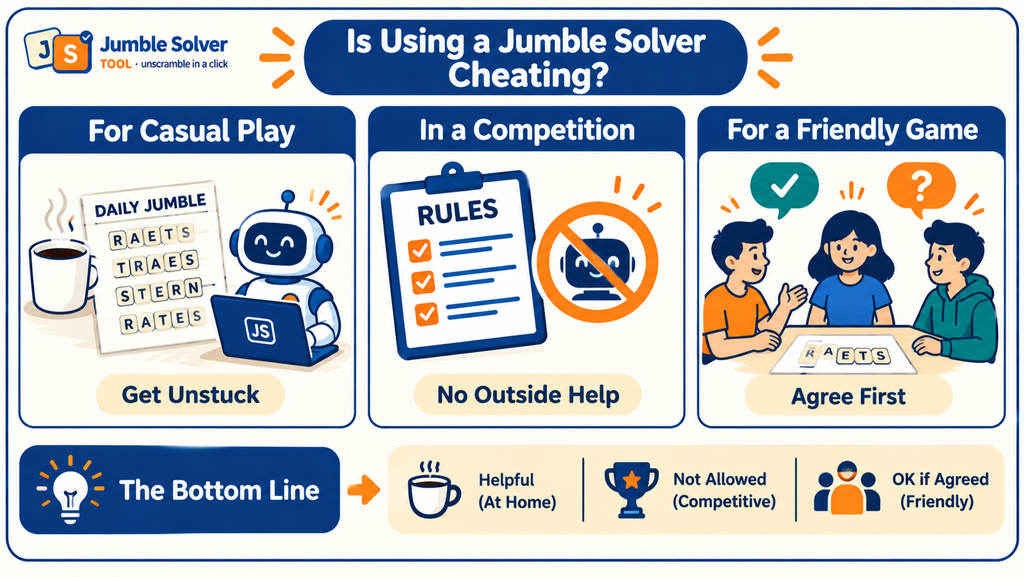
So, is using a jumble solver cheating? It depends on what you’re doing. If you’re solving the Daily Jumble over coffee and one word has you stuck, using a solver to check an answer or spot a letter pattern is simply a way to get unstuck. It can also help you recognize patterns faster next time.
In a competition, league game, or online match where outside help isn’t allowed, using a solver would break the rules. For a friendly game, the simplest approach is to agree beforehand whether helpers are allowed.
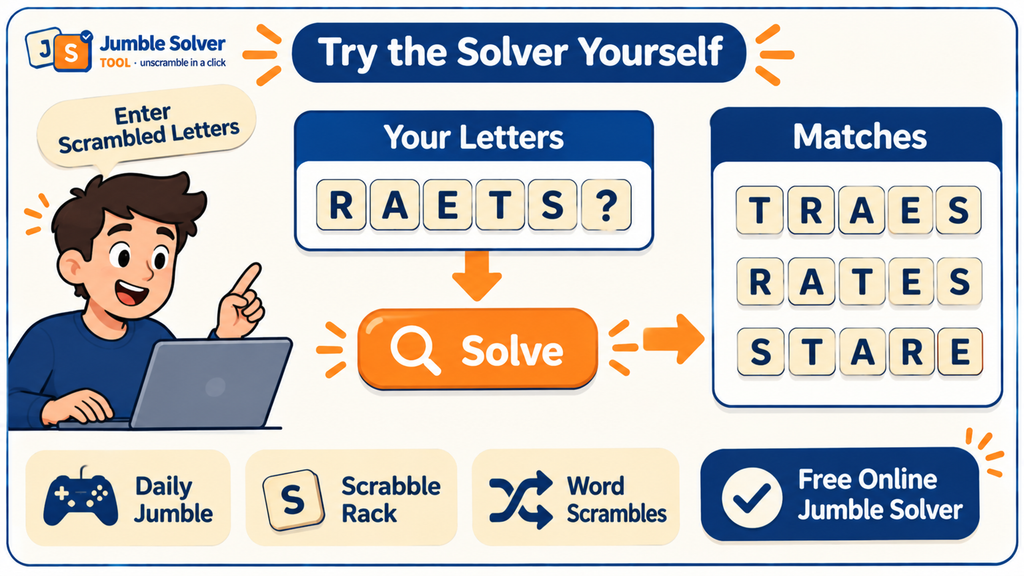
Try the Solver Yourself
Now that you know how a jumble solver works behind the “Solve” button, give it a try. Enter your scrambled letters, add a wildcard (?) for any letter you’re unsure about, and see the matches returned from the tool’s word list.
Use our free jumble solver online when you’re stuck on today’s Daily Jumble, a Scrabble rack, or another word scramble.
Ready to put it into practice? Try these tricks to solve jumble puzzles fast, check the Daily Jumble answers, or learn the difference between anagrams and word scrambles.