Anagram vs Word Scramble: What’s the Difference Between Them and a Jumble?
An anagram is a new word or phrase made by rearranging every letter of another word or phrase, the way LISTEN becomes SILENT. A word scramble hands you letters out of order and asks you to put them back. A Jumble is a newspaper puzzle built from scrambles, with circled letters that lead to a punny final answer. That’s the anagram vs word scramble question in three sentences. The details are where people get tripped up.
The Short Answer: How Are They Different?
The difference between anagram and word scramble puzzles comes down to where you start. An anagram starts with a word or phrase. A scramble starts with mixed-up letters.
| Anagram | Word Scramble | Jumble | |
| What it is | A rearrangement of a word’s or phrase’s letters | A puzzle of mixed-up letters | A newspaper puzzle built from several scrambles |
| You start with | A word or phrase | Letters out of order | Four scrambled words and a cartoon clue |
| Letters used | Every letter, exactly once | Usually every given letter | Every letter in each word; selected letters form the final answer |
| How many answers | Sometimes several (LISTEN, SILENT, ENLIST) | One intended, sometimes more | One intended answer per word |
| Clue | Not always needed | Sometimes a theme or hint | A cartoon clue for the final pun |
| What it’s for | Wordplay | Practice, games, worksheets | A brain teaser with a punchline |
Put simply: solving a typical word scramble produces an anagram of its letters. But not every anagram is part of a puzzle.

What Is an Anagram?
Anagram Meaning and Definition
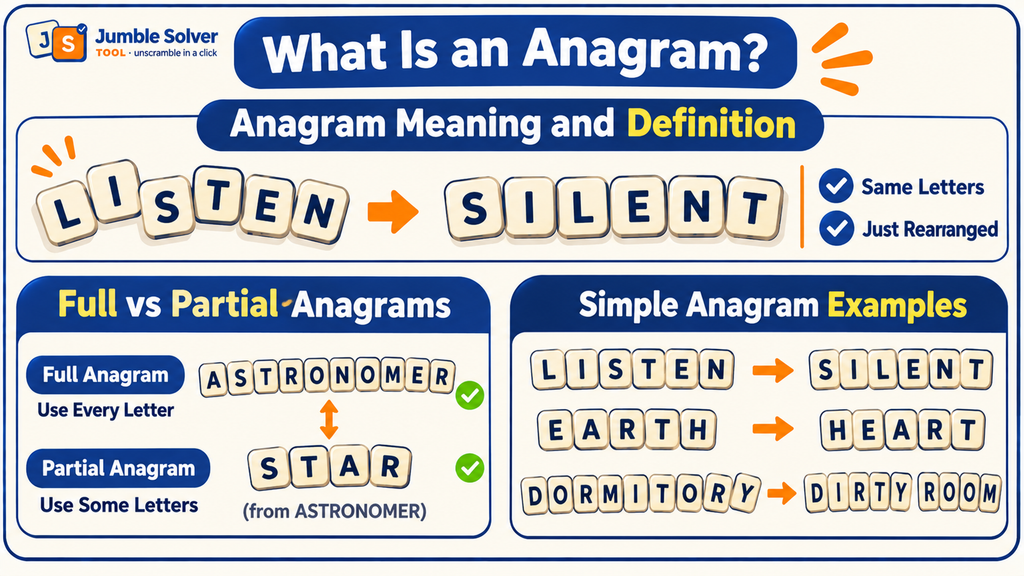
An anagram is a word or phrase formed by rearranging the letters of another, using each letter exactly as many times as it appears in the original. Two Rs in, two Rs out. That letter-count rule is the entire test.
Each arrangement is called a permutation, but only those forming meaningful words or phrases count as anagrams. The word comes from Greek: ana- (back, again) plus gramma (letter). Merriam-Webster dates its first known English use to 1589. People have been shuffling letters for fun, and for pen names, for centuries.
Full and Partial Anagrams
A full anagram uses every letter. That’s what the standard definition requires. A partial anagram uses only some letters, like STAR pulled from ASTRONOMER. Word-finder tools list these as “words you can make,” and they’re handy for a Scrabble rack. Strictly speaking, though, STAR isn’t a full anagram of ASTRONOMER.
Simple Anagram Examples
- LISTEN → SILENT
- EARTH → HEART
- DORMITORY → DIRTY ROOM
That last one matters. A multi-word anagram can cross word boundaries, as long as every letter matches exactly.
What Is a Word Scramble?
A word scramble is less a kind of word than a kind of puzzle. Someone takes a word, mixes up the letters, and your job is to put it back together. That’s the basic word scramble meaning.
How Single-Word Scrambles Work
This is the version you see on classroom worksheets and in casual phone games. There’s usually a theme, such as animals, spelling-list words, or holidays. The theme does a lot of quiet work. TAC on a pets worksheet is CAT. Nobody expects ACT.
Word Scrambles With Multiple Answers
Take the theme away and things get messier. The letters EVLI can spell LIVE, EVIL, VILE, or VEIL. Without a clue, all four are valid answers. Some scramble games lean into this on purpose. They score every valid word you find, including shorter ones that use only some of the letters.
Word Scrambler vs Word Unscrambler
These tools run in opposite directions. A word scrambler takes a real word and mixes up its letters, which is useful for making worksheets. A word unscrambler takes scrambled letters and lists possible words. These word scramble examples show why a clue can make all the difference.

What Is a Word Jumble?
“Jumble” has two meanings. In everyday use, a jumble is a mix of letters or words out of order. Capitalized, Jumble is a specific, trademarked newspaper puzzle. That’s the basic jumble meaning.
What Is the Daily Jumble Newspaper Puzzle?
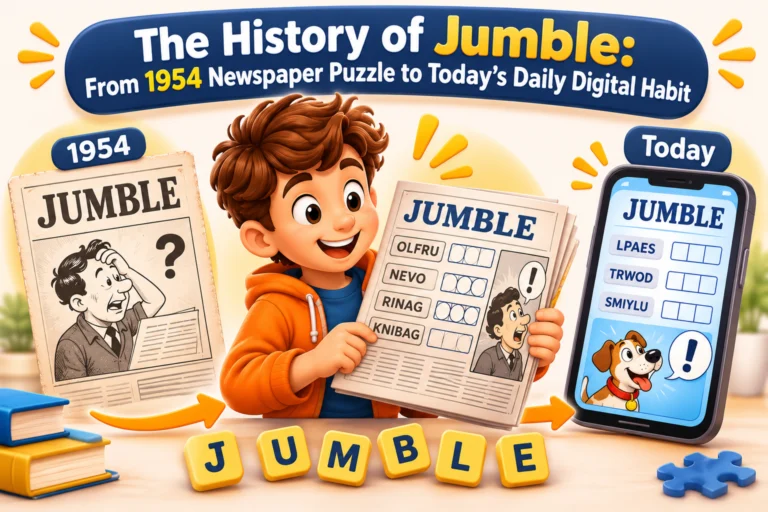
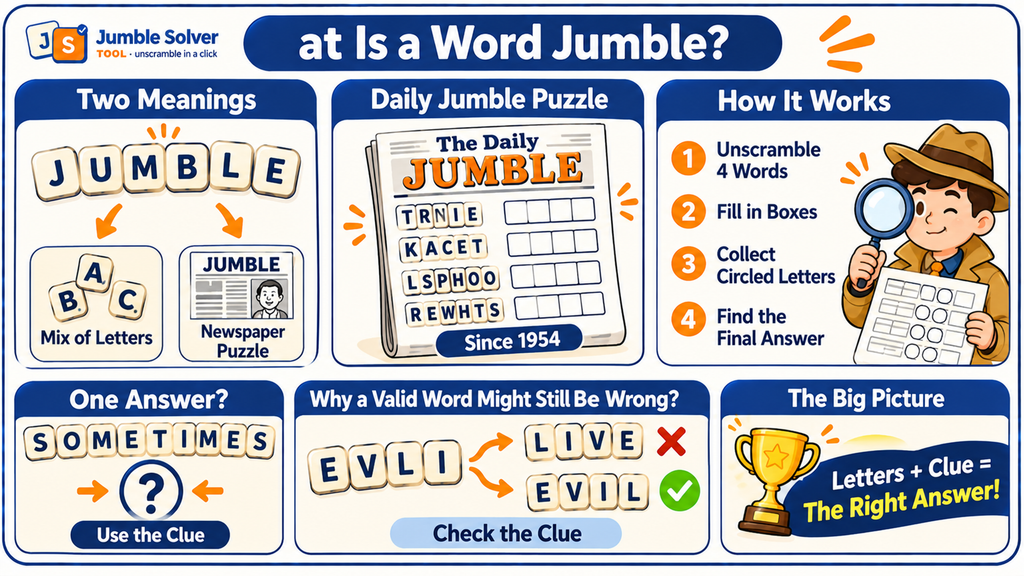
Daily Jumble began in 1954, created by comic-book artist Martin Naydel under the original name “Scramble.” Today, Tribune Content Agency distributes it, with puzzles created by David L. Hoyt and cartoonist Jeff Knurek. You’ll find it in newspapers across the US and online.
How Does the Daily Jumble Work?
The jumble puzzle rules are simple:
- Unscramble four words. The standard daily puzzle has two five-letter words and two six-letter words.
- Write each answer in its boxes. Some boxes are circled.
- Collect the circled letters from the solved words.
- Rearrange them to complete the cartoon’s clue, usually with a funny pun as the final answer.
Experienced solvers sometimes work backward. They guess the punchline from the cartoon, then use those letters to crack a stubborn word.
Can a Jumble Have More Than One Answer?
Sometimes. The same letters can form multiple valid words, but the puzzle has one intended solution. The circled positions and cartoon clue help you find it. If your word fits but the punchline doesn’t, try another rearrangement.
Why a valid word might still be wrong? Suppose your scrambled letters are EVLI. You find LIVE, but the puzzle’s clue points to something harmful. EVIL also uses every letter, and it fits the hint better. That’s why checking the clue matters as much as matching the letters.
Anagram vs Word Scramble: Key Differences Explained
Most explanations of anagram vs word scramble stop at “they’re basically the same thing.” They share a mechanic. They don’t share a job. Four things separate them.
- Starting point. An anagram puzzle starts with a real word and rearranges its letters into another (EARTH → HEART). A scramble starts with mixed-up letters, like RHETA, and asks you to find the hidden word.
- Expected answers. Anagrams can have several valid results. Scrambles usually have one intended answer, with a theme or clue to help narrow it down.
- Direction. Creating anagrams is a form of wordplay. Solving scrambled words feels more like detective work. The same letter arrangement process works in reverse.
- Purpose. Anagrams show how words relate. Scrambles turn that relationship into a puzzle for worksheets, apps, and newspapers.
That’s the real anagram vs word scramble split: one describes a relationship between words, while the other is a puzzle built around it. The word scramble vs jumble distinction is similar. A Jumble combines several scrambles with a cartoon clue and a final punchline.

Jumble vs Anagram: Are They the Same?
Close, but not quite. Each solved Jumble word is an anagram of its original scrambled letters. The basic letter-rearranging process is the same.
The main difference between jumble and anagram puzzles is structure. An anagram can stand on its own. A Jumble combines four scrambled words, marks certain letter positions with circles, and adds a cartoon clue. Those selected letters help you work out the final pun. A Jumble also aims for one intended answer per word, even when other valid rearrangements exist. Without clues, an anagram may have several possible results.
There’s also the capital letter. A “word jumble” in a kids’ activity book is simply a scrambled-word puzzle. Jumble, with a capital J, is the branded newspaper game. So, in a jumble vs anagram comparison, both use the same letter trick, but only Jumble follows that familiar newspaper format. That’s usually what readers mean by anagram vs jumble.
Same Letters, Three Different Word Puzzles
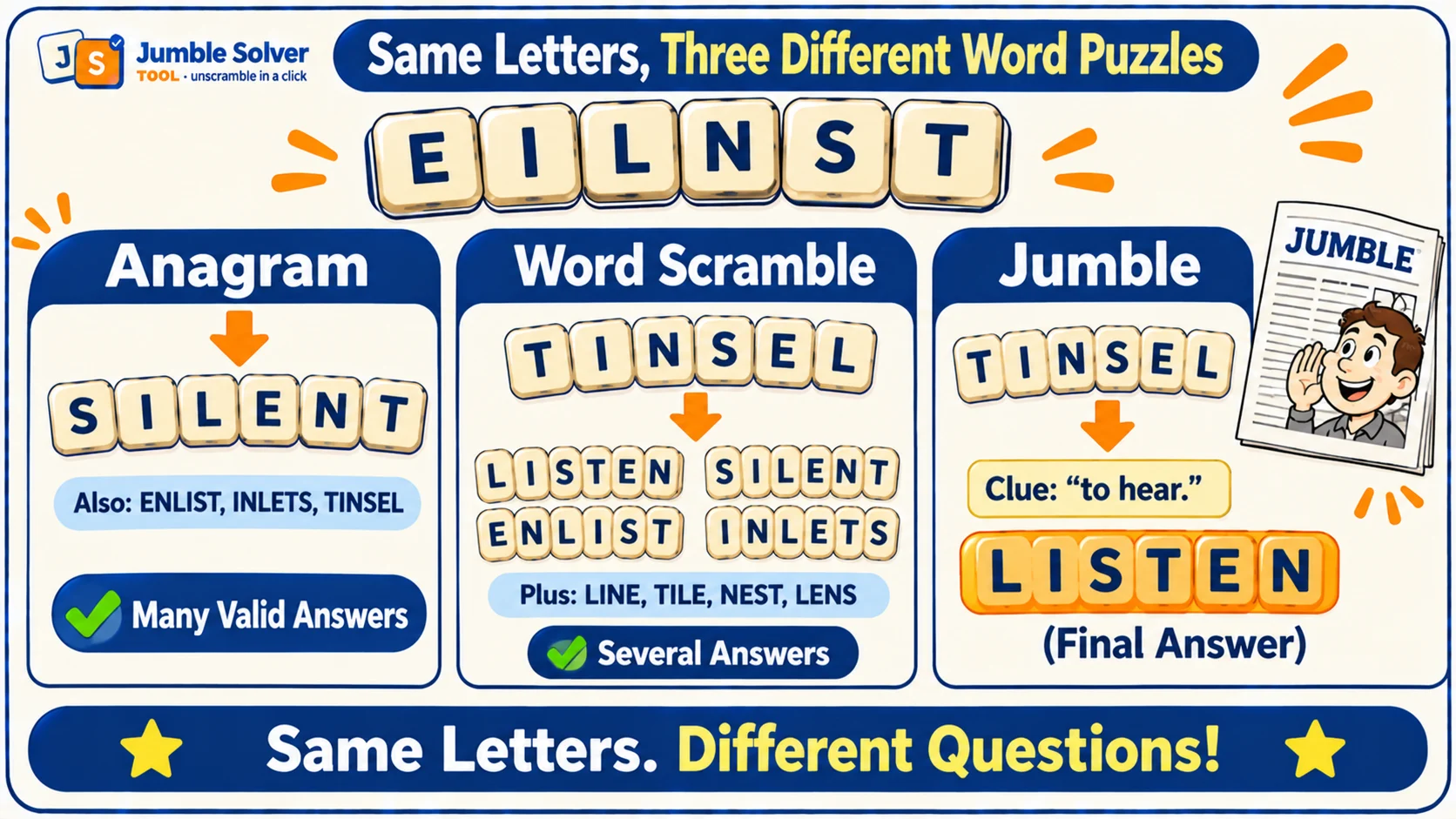
The easiest way to see anagram vs word scramble in action is with one set of letters: E, I, L, N, S, T. Watch what changes depending on which puzzle you’re playing.
As an anagram: LISTEN → SILENT. The same letters also make ENLIST, INLETS, and TINSEL. Every one is a valid anagram. None is more correct than the others.
As a word scramble: You’re handed TINSEL and told to unscramble it. Without a hint, LISTEN, SILENT, ENLIST, and INLETS are all valid answers. In a find-as-many-words game, you could also score shorter words like LINE, TILE, NEST, and LENS.
As a Jumble-style clue: TINSEL comes with the puzzle clue “to hear.” Now LISTEN is the intended answer.
Same six letters, three different questions. These word scramble examples show how a clue can narrow several valid answers down to one.
That’s what makes anagram vs word scramble worth understanding: the letters may be identical, but the task changes.
Which Solver Should You Use?
Once the anagram vs word scramble distinction clicks, picking a tool gets simple. Go by what you’re stuck on, not what the puzzle happens to be called.
| Your puzzle | Tool to use | What you should get back |
| A newspaper Jumble word | Jumble Solver | Full-length words using all your letters |
| An anagram puzzle | Anagram Solver | Valid rearrangements, sometimes phrases |
| Mixed letters from a game | Word Unscrambler | Possible words sorted by length |
| A Scrabble or Words With Friends rack | Game-specific word finder | Playable words and point values |
If you’re wondering how to find words from scrambled letters, the right tool can save time. A general unscrambler may return dozens of short words when your Jumble needs a six-letter answer. That’s where our Jumble Solver comes in. Enter your scrambled letters to look for full-length matches. If several words fit, use the circled letters and cartoon clue to narrow them down.
One catch for board-game players: North American tournament Scrabble uses the NWL word list, while international competitions commonly use Collins. So a word accepted by one dictionary might not appear in another.

Not to Be Confused With Other Word Puzzles
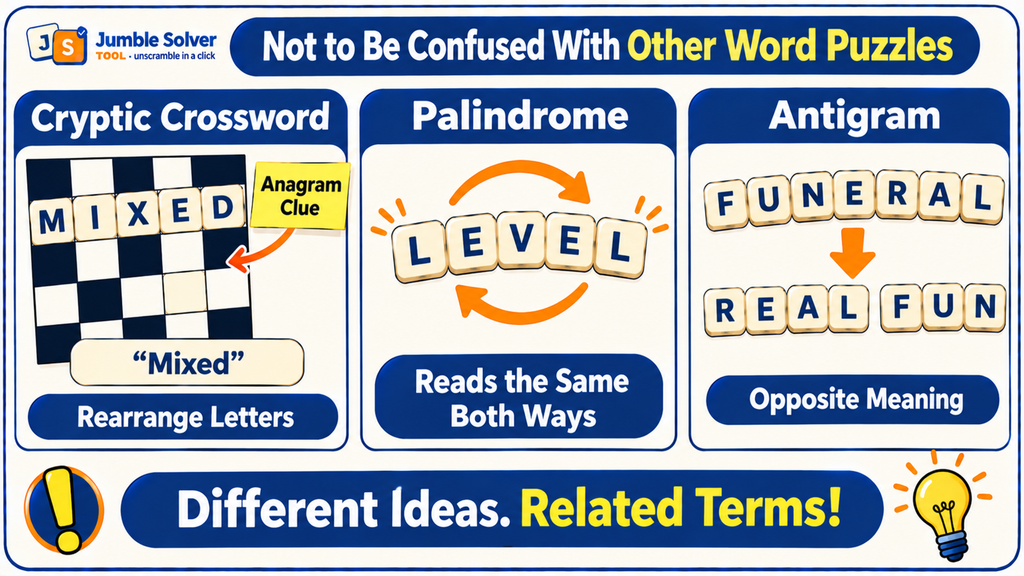
A few other terms get lumped in with anagrams. They’re related, but they work differently.
Cryptic crossword: A puzzle where an anagram clue uses signal words like “mixed,” “broken,” or “confused” to tell you to rearrange certain letters.
Palindrome: A word that reads the same backward and forward, like LEVEL or RACECAR. Nothing gets rearranged, which is the whole anagram vs palindrome difference.
Antigram: An anagram with an opposite or contrasting meaning, such as FUNERAL → REAL FUN. That’s what makes anagram vs antigram worth distinguishing.
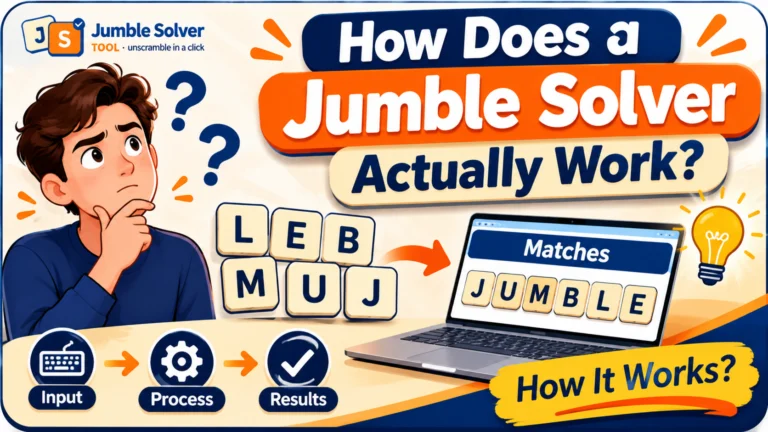
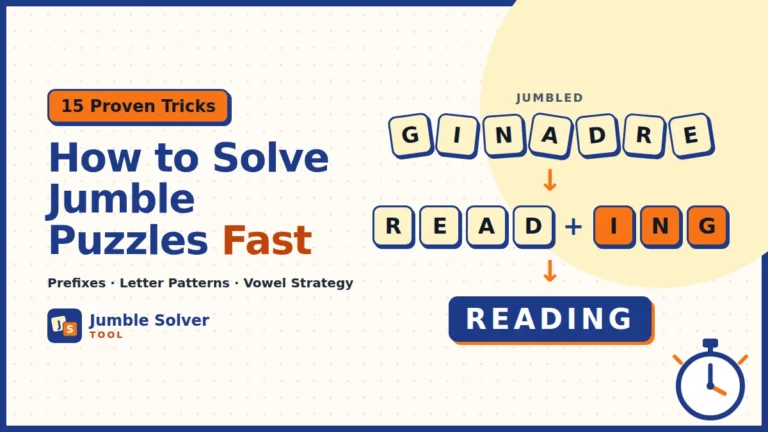
To put this into practice, read how a jumble solver works, follow our tips to solve jumble puzzles fast, or browse the full puzzle guide.
Frequently Asked Questions
Conclusion
An anagram is a relationship between words or phrases. A word scramble is a puzzle built around rearranging letters, and Jumble takes it further with a cartoon clue and a pun at the end. Once you see anagram vs word scramble that way, the terms stop blurring together.
Found more than one possible answer?
Try your letters in our Jumble Solver to see possible matches. Then use your puzzle’s circled letters and cartoon clue to choose the answer that fits.